
A converted construction container is much more than just a metal space: it becomes a strategic tool for the construction industry, transformable into an office, living quarters, workshop, or storage area. Designed to meet the specific needs of each site, it offers customized , practical, and secure solutions. Thanks to its numerous layout options —electrical, plumbing, insulation, ventilation, and partitions—the container can be easily personalized to create a functional, modular, and turnkey work environment.
In short, here are the most important points to remember:
- Un converted construction site container is a modular structure transformed to meet the needs of the construction industry: offices, storage, base camp, workshops or collaborative spaces.
- The possible arrangements include electricity, computer network, sanitary facilities, insulation, ventilation, floor coverings, openings and modular partitions.
- These modules offer major advantages : robustness (Corten steel), anti-burglary security, compliance with fire and anti-corrosion standards, speed of installation and flexibility.
- Containers can be adapted to concrete use cases : mobile workshop on an isolated site, complete base camp for teams, supervision office or technical room for electricity and data.
- With over 30 years of experience and an in-house design office, Oxymontage offers turnkey solutions, compliant with standards and immediately usable, from design to delivery.
To go further and learn everything about this article, I invite you to read the article.

Summary
Understanding the role of the construction site container
What is a converted construction site container?
A converted construction container is a metal structure made from a standard shipping container, modified to meet the needs of the construction industry. Unlike a simple storage container, it incorporates functional spaces adapted to on-site working conditions: office areas, mobile workshops, restrooms, and changing rooms. Thanks to its modular design, it can be delivered ready to use and installed quickly, without major construction work.
Main uses in the construction sector
In construction and public works, the converted container fulfills several key functions:
- Encrypted Storage of sensitive tools and materials.
- Technical offices for the daily management of the site.
- Base camps with changing rooms, dining rooms and toilets for the teams.
- Mobile workshops to carry out repairs or preparations on site.
- Collaborative spaces as meeting or supervision rooms.
These uses make it a practical and economical solution for organizing the construction site and meeting the immediate needs of professionals.
Why choose containers over traditional temporary structures?
The construction container offers several advantages over lightweight construction or a site bungalow. Its robustness (Corten steel), durability , and security (reinforced locks, anti-theft features) guarantee optimal protection for equipment and personnel. Its modularity also allows for the creation of multi-container units to form true logistics hubs, adaptable to the various phases of the project.
The main types of possible developments
Secure storage of tools and materials
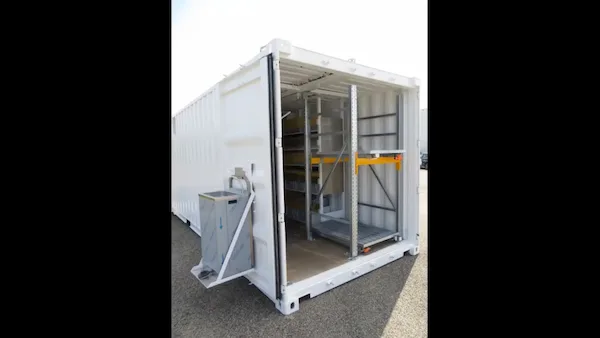
The primary use of a container on a construction site is storage . Equipped with shelves, racks, or containment areas, it allows for the secure storage of tools, consumables, and materials. Locking systems using reinforced padlocks or high-security locks reduce the risk of theft. Insulation and ventilation also protect sensitive materials from moisture.

Technical offices and supervisory positions
A converted shipping container can be transformed into a temporary office for site managers or foremen. Equipped with electricity, RJ45 sockets, LED lighting, and insulated partitions, it offers a comfortable working environment right on the construction site. It's an ideal solution for document management, quick meetings, or real-time monitoring of project progress.
Base camps: changing rooms, dining rooms and toilets
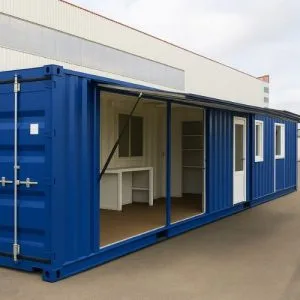
Construction teams require rest and hygiene facilities that meet standards. The converted container therefore includes changing rooms with benches and lockers, a canteen equipped with tables, chairs and a kitchenette, as well as complete sanitary facilities (toilets, sinks, showers). These spaces improve daily comfort and contribute to compliance with current regulations on working conditions.

Mobile workshops for maintenance or welding
Some projects require on-site technical operations. The converted container then becomes a mobile workshop , equipped with workbenches, tool trolleys, and ventilation and air extraction systems. It can also incorporate a hoist or handling rails to facilitate the handling of heavy parts. This configuration reduces back-and-forth trips and increases team productivity.
Meeting rooms and collaborative spaces
Beyond offices, the container can house a meeting room, allowing teams to plan and coordinate their activities. Partitioned and soundproofed, this space fosters communication between different professions and serves as a reception area for external partners.
Technical options for customizing your container
Electrical and network installations
To be fully functional, a construction container can integrate a complete electrical network :
- 220 V sockets for current equipment,
- 380 V sockets for machines,
- economical LED lighting,
- convectors or electric heaters,
- RJ45 sockets and computer network.
These installations are designed to withstand construction site conditions while respecting safety standards.
Sanitation and water management
A converted construction container can incorporate complete sanitary facilities : showers, toilets, sinks, a hot water tank, and connected drainage. In some cases, a self-sufficient water tank is included for remote sites. This configuration ensures a high level of comfort for the teams and meets legal requirements.
Thermal, sound and fire insulation
Insulation is an essential step in making the container pleasant to use . Common solutions include:
- insulating sandwich panels,
- rock wool for thermal comfort,
- fire-resistant linings for safety,
- acoustic treatments to limit noise.
These options help maintain a stable temperature and provide greater working comfort, even in extreme environments.
Ventilation, heating and air conditioning (HVAC)
Air management is essential in an enclosed space. The container can incorporate:
- mechanical ventilation,
- air extractors,
- reversible air conditioning,
- suitable heating.
This equipment guarantees a healthy and safe environment, particularly in welding workshops or storage areas for sensitive products.
Floor coverings and interior finishes
Depending on the intended use, various floor coverings can be installed: resin for chemical resistance, linoleum for comfort, and steel or aluminum for technical areas. Interior finishes also include wall coverings, suspended ceilings, and appropriate joinery.
Openings and joinery
Converted containers can be equipped with glass doors, windows, sliding doors , or even opening side panels . These features improve lighting, facilitate access, and increase the module's functionality.
Modular partitions and internal organization
Modular partitions allow for the separation of storage areas, offices, or restrooms. This flexibility is essential for creating spaces that adapt to the evolving needs of the construction site.
Integrated lifting and handling systems
For certain projects, a container can be equipped with integrated handling rails, hoists, or lifting systems . These solutions facilitate the handling of tools and heavy parts directly on site.
Possible services and equipment
To meet the varied needs of a construction site, a converted container can include complete services, organized by functional zones:
- Electricity : HYPRA outdoor socket, LED lighting, 220 V and 380 V sockets, RJ45 sockets for computer network, air extractor, convector.
- Plumbing : water inlets and outlets, hot water tank, shower, toilet, autonomous tank for drinking water, wastewater management.
- Atelier : shelving, workbench, trolleys, handling hoist, welding table, drill press.
- Cloakroom : individual lockers, benches, resin floor with water drain for easy maintenance.
- Refectory : complete furniture, fridge, microwave, table and benches, moleskin for comfort.
- Design : windows, storage cabinet, functional desk, chest of drawers.
Safety, Compliance and Standards
Structural strength and stability
The construction container is made of Corten steel , renowned for its strength and corrosion resistance. Structural reinforcements can be added during the conversion process to ensure stability even after the installation of windows or doors.
Fire protection and REI/EI standards
To ensure the safety of the teams, the converted containers can be fitted with fire-resistant insulation that meets REI/EI standards. In the case of sensitive sites (petrochemical, offshore), specific certifications such as IMO or SOLAS may be required.
Anti-burglary security (CR3/CR4)
One of the major advantages of a converted container is its ability to be secured against intrusion . Reinforced closures, CR3 or CR4 certified locks, metal grilles and shutters ensure the protection of stored tools and equipment.
Painting and anti-corrosion treatment (ISO 12944)
Containers are subjected to varying climatic conditions. An anti-corrosion treatment, compliant with ISO 12944 , extends their lifespan and ensures better resistance to external aggressions.
The key advantages of converted construction site containers
Speed of commissioning and flexibility
One of the major advantages of a construction container is its rapid deployment . Unlike traditional buildings, it is delivered ready to use and requires minimal on-site preparation. This flexibility allows for quick adaptation of the site layout to changing needs: adding offices, creating a site office, or expanding a mobile workshop.
Robustness and durability on site
Made of Corten steel, the shipping container is designed to withstand the most demanding conditions. Transformed into a construction site module, it retains this structural strength , guaranteeing a long lifespan. It easily withstands inclement weather, temperature variations, and the harsh conditions encountered on construction sites.
Modularity and scalability of spaces
Thanks to its modular design, the converted container is scalable . Several modules can be placed side-by-side or stacked to create configurations adapted to the size and duration of the project. This adaptability makes the container particularly suitable for large construction sites requiring varied and adjustable spaces.
Turnkey solution adapted to demanding environments
Oxymontage offers turnkey, fully equipped shipping containers , incorporating all necessary installations: electricity, insulation, ventilation, joinery, and finishes. This approach allows construction companies to benefit from a functional, secure, and immediately usable space, regardless of the project context.
Concrete use cases in the construction industry
Example of a mobile workshop on an isolated construction site
At a site far from existing infrastructure, a converted shipping container workshop, equipped with workbenches, tool trolleys, and ventilation, provides teams with a functional technical space. This type of module reduces travel time and ensures improved productivity.
Example of a complete base camp for a team
Large-scale construction projects often require housing and sanitary facilities for workers. A set of converted shipping containers can provide a complete site compound with changing rooms, a canteen, restrooms, and rest areas. This solution meets hygiene standards and improves the daily comfort of the teams.
Example of an office container for site monitoring
A converted shipping container office placed at the heart of a construction site provides project managers with a supervisory space. Equipped with electricity, a computer network, and suitable furniture, it becomes a true command center, facilitating the coordination of the various trades involved.
Example of a technical container for electricity and data
Some construction sites require specific network management. A technical container, fitted out to house transformers, electrical cabinets, or computer servers, ensures reliable power and connectivity. The installations are secure and compliant with standards, guaranteeing optimal operation.
How to make your development project a success?
Identify functional needs from the design stage
The success of a development project hinges on a precise needs analysis . Should the focus be on storage, creating workspaces, or accommodating teams? This step determines the technical options to be integrated (sanitary facilities, insulation, ventilation, networks).
Define the areas: storage, office, sanitary, workshop
Each container must be designed to serve a clear purpose . Defining the zones from the outset optimizes the available space and ensures efficient use. A container can, for example, combine a workshop and an office space, separated by an insulated partition.
Working with a specialist design office
Successful container conversion requires technical expertise. Oxymontage's design office supports each project by offering tailored solutions: structural calculations, material selection, and compliance with electrical and sanitary standards. This approach guarantees the container's conformity and durability.
Plan logistics and on-site installation
Handling and installation must be planned in advance. A converted container can be delivered ready to use, but site access, unloading, and placement (often via a hooklift or crane) must be arranged. Good logistical preparation reduces delays and ensures a smooth commissioning.
Why choose Oxymontage for your converted containers?
30 years of experience and more than 350 units/year
Oxymontage draws on solid experience in container conversion . With more than 350 units produced each year, the company is a recognized player in the sector, capable of responding to varied and demanding projects.
In-house design office for tailor-made projects
Each project is studied by a team of engineers and designers using the most advanced CAD software. This allows us to offer perfectly tailored solutions, from a simple office container to a multi-module site accommodation unit.
A 28,000 m² industrial site with over 100 containers in stock
With a large-capacity industrial park, Oxymontage maintains readily available stock . This responsiveness allows them to quickly meet the needs of construction sites, while guaranteeing short production and delivery times.
Certifications, compliance and testing guaranteed
All converted containers meet safety and quality standards : CSC for transport, REI/EI for fire protection, CR3/CR4 for burglary resistance, and ISO 12944 for anti-corrosion paints. Each project undergoes rigorous controls and factory testing.
A turnkey approach, from design to delivery
Oxymontage provides comprehensive project management: design, manufacturing, equipment integration, and on-site delivery. This approach guarantees a turnkey solution , reducing complexity for client companies.
Conclusion
A converted construction container is not just a simple metal box: it's a modular, secure, and turnkey solution that adapts to all the needs of the construction industry. Whether it's creating a secure storage space, a technical office, a complete site accommodation unit, or a mobile workshop, the conversion possibilities are numerous. Thanks to its expertise, design office, and industrial capabilities, Oxymontage supports each project with customized, compliant, and ready-to-use solutions.